Monday, February 29, 2016

Give a Kid a Block...

Each time I teach yoga to the preschooler's it's a challenge to make sure I incorporate enough "old stuff" to reinforce memory, create consistency, and set the framework for the arc of class but also bring in enough "new stuff" to make the classes interesting, exciting, challenging, and unique.

The very young children (under 3) are quite content over the course of their school year to practice the yoga moves with my well-used songs by Karen K and the Jitterbugs, Laurie Berkner, Feist, and Elizabeth Mitchell to name a few. They are called to action by the music, the melodies, my (off key) singing - familiarity bring comfort and with comfort comes more exploration with how their bodies move in the space in which we do yoga.

But the children that are over 3, and up to 5, while they love the tried and true music and games, are open to using their yoga skills in new ways. Skills like balance, the ability to go from silly to calm, being creative, cooperating, and even teaching (each other).

Some days, offering them new tools like blocks or balls may prove to be too much so we simply continue to use our bodies (without any potential projectiles).

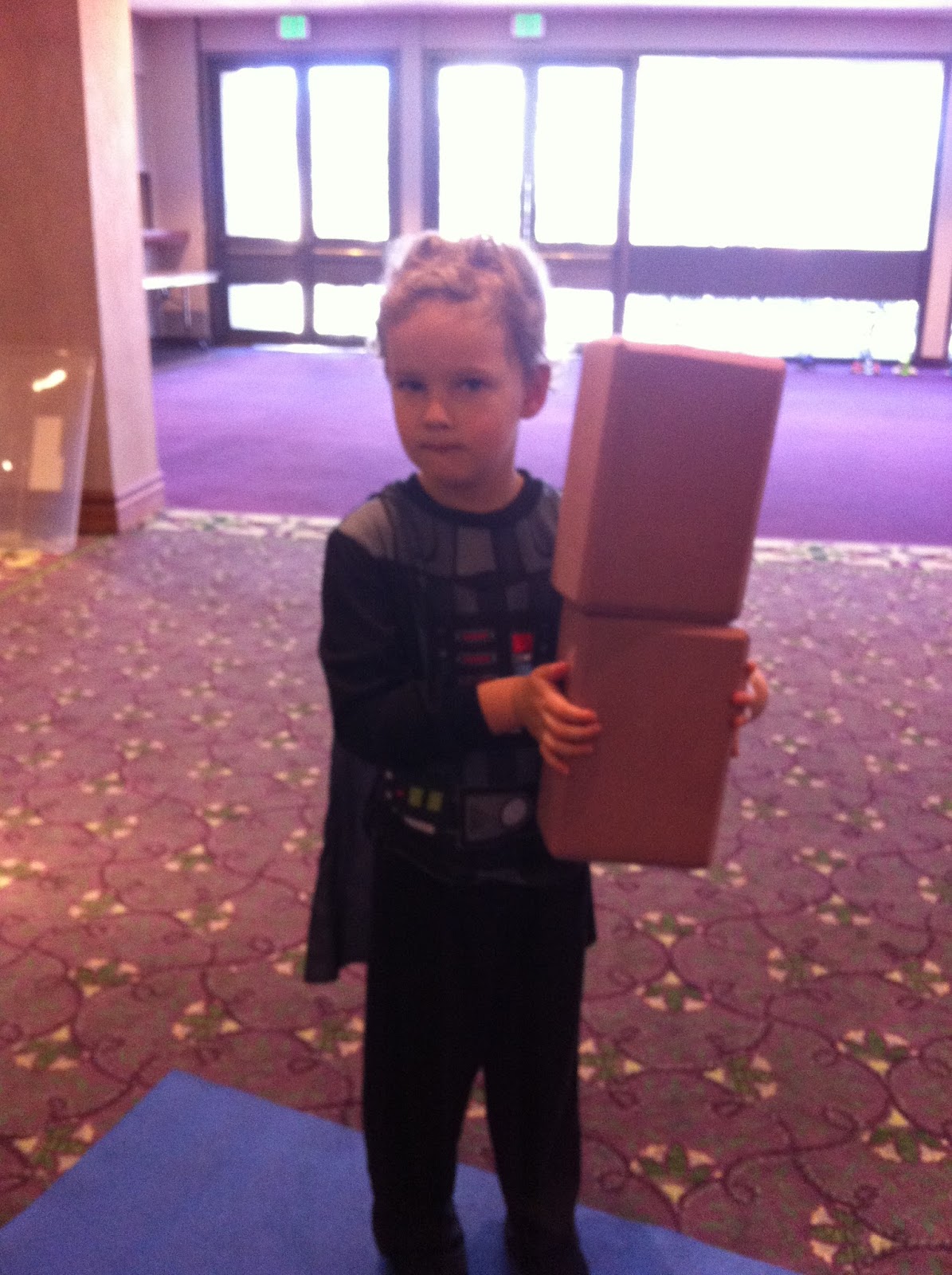
But some days, when the stars align and the mood is right, I can offer them one or two foam blocks each, and a yoga mat, and ask them "How can you do yoga with these?"

The results? See for yourself:

First we had a lot of just block stacking.
Then, the idea to stand on the blocks  trended.
Even on one foot.
Adding little arm and leg flair too.
Well, not just standing, kneeling too!
Then kneeling and leaning... 
And FLOATING. 
Floating on the belly was a big hit.
That idea proved quite popular
Group belly balancing

Superhero or Manta ray - awesome
And finally, on the back. 
Then truly restorative
Of course I had to set limits so that the blocks were used safely - no standing on blocks that were on end, no kicking/throwing, and no stealing other people's blocks. 

Sometimes, the Hoberman Sphere is a bigger draw. With absolutely no prompting from me, they find their own safe space inside it, using it to create a safe space for their mind and body, in true yogic style.


I can't wait to see what they will create with me next class.

Monday, February 22, 2016

Free Yoga All Over San Diego County

Our local library system for the county has a PLETHORA (a veritable cornucopia) of free yoga classes at multiple locations on any given day, for all ages (kids, families, seniors, disabilities and more). If you want to find a FREE class near you, please just check out the county library website... and be amazed! Many times its the Friend of the Library organizations supporting the classes; sometimes it's private groups and sometimes it's a complete labor of love on the part of the instructor.  Highly encourage you to explore your options!

http://host.evanced.info/sdcl/evanced/eventcalendar.asp

Saturday, January 30, 2016

Music - an opinion piece

Nothing about my teaching lately has drawn more controversy than my music choices. I mix up my class soundtracks, spinning (well, playing) everything from Queen, Sanskrit chanting, native rhythms, nature sounds, and classical guitar, to coffee shop soundtracks. Whatever seems to suit the mood, my mood the class, the day. Sometimes, I choose incorrectly, Sometimes I have to change it up during class. Sometimes I just have to turn it off.

For flow-based classes I like to have music that moves us through our postures. Most of my classes, even if they have flow, include quite a bit of narration so I have to keep the music at a level that I can talk over it, not compete with it. Sometimes it conflicts, I admit, and sometimes it really elevates the tone of the class - really jives.  Sometimes I'll reference to the music to just help us get into the mood, get the breath flowing, open the heart, or build heat. You never know what will truly "work," but I'd like to think that regardless the music is just background and my instruction in the foreground.

I had an instructor that insisted on wordless music in her classes, and for any practice class you taught with or for her, on the principle that words (English in particular) were a distraction for the mind. I respect her enough to take the advice to heart and understand its intent, but I also feel the need to experiment with the idea of more "lyrical" yoga.

I've had other instructors that were really skillful in creating playlists that boosted energy levels with funk (think Gap band), or world beat (modern Sting), or classic rock (yes, even Journey) in such a joyous way that you would be hard pressed to not want to move and flow gloriously in Urdva Hastasana, swan dive elegantly into Uttanasana, float strongly back into Chaturanga, expose the heart through strengthened arms in Urdva Mukha Savansana and then open the hamstrings and find length in the spine in Adho Mukha Savanasaa. Leg and core engaging poses like plank, warrior II, side plank, and reverse warrior can made even more powerful when music lifts and lyrics surge. Forward folds can be even more releasing when musical phrases descend and lyrics become winsome and soft.

In one recent class, a student gave me a softly-toned "science" lecture on why I should not use music with lyrics. The reasoning was that the lyrics stimulated the brain, therefore preventing one from properly immersing themselves in the blissful flow of the yoga practice.
\
I've had some students say they don't notice the music as they are really focusing on their practice.Yesterday someone said they would prefer lyrics in any other language but English because if they recognize words they stop listening to me and start only listening to the music. Today someone said "I would just like to hear the East Indian bells and instruments it really takes me into the mood."

Other students have commented that they love some of playlists with familiar songs because it lightens the mood for them, it keeps them from getting too "in their own heads."

I define the difference between "going inward" and "being in your head" this way: as much in yoga you are working the 8 limbs to bring yourself to center, yoke together your mind and body, at any point there can be a tendency to over-think, over-analyze, and attempt to over-perform. The monkey mind can race out of the room as soon as it doesn't have a good reason to stay in. So for some, a vivid soundtrack, music with familiar lyrics included, can help them stay in tune with the class, in the moment, and in the mood. It can facilitate connecting with the breath flow back into their bodies rather than out the door or creating a downward spiraling of the the mind.

For me personally, lyrics or not, I find that familiar music keeps all of me integrated and flowing. I can tune in to the instructor or tune out - the choice is MINE and I cannot blame the music for any of those choices.

Funny - more often than not people do comment when they like the playlist - no matter if it's familiar tunes with words, acoustic covers, classical pieces, soundtracks, Sanskrit chanting - everyone likes something different. Sometimes I get a big thank you when a classic favorite comes on like the Beatles "Let It Be" because it really does bring out the heart. For me, the Leonard Cohen song "Hallelujah" draws forth tears almost every listen and really really helps me find depth in my practice because I feel that I'm connected with energy in the deepest recesses of my soul. What is yoga if not that?

So I have to think - when I teach am I playing the music for me, or for the class? I want to create a soundtrack for the class the moves them, that engages them, that feels right to me. And of course I want it to be music that I like (after all, I'm teaching). I suppose it can be a class without music. I've tried that too - and every single time at least one person nervously speaks up and says "We are  going to have music aren't we" as if it the lack of music creates a a vacuum in which one simply could not practice!

So, it's impossible to say set a rule that works for everyone. Because we have different tastes. And moods. and situations, day to day, and hour to hour. Each needing a little bit different attention.

Truth be told this is a heated topic in the yoga world, with probably the most widely used reason is that hearing lyrics conflicts with the calming of the mind. One article went so far as to say that lyrics can counter-productively plant subliminal messages in the unconscious minds of the yogis - a sad song can create a very negative effect on that class, and song with angry or hurtful lyrics can be particular destructive. Yes music is a powerful tool, but my intent is never to use it maliciously.

One issue with which I can agree is that if the volume balance is off, the music can compete with teacher instruction. I don't like to use voice amplification, so proper volume is important. And being aware if the selected songs are just not working... still being responsible for observing your class, reading the class, teaching the class. Change the music if it's not working, or even turn it off. The music is a tool, YOU the instructor.

Just as an aside, in kids classes we use music as a key component to get their attention, to help them coordinate movement with breath, and help them learn movement pattern in the spirit of yoga-oriented play. Music with lyrics makes that task a lot easier as it also stimulates their little minds to remember words and synchronize poses. So, there's that.

In conclusion I have a couple of suggestions for other yoga teachers (and myself)

1) there is no hard and fast rule unless you make one yourself
2) you can't please everyone (but let's not get snarky - this is yoga after all)
3) know your audience in general (and yourself)
4) be mindful with your music choices (see  #2 &#3)
5) experiment a little anyway
6) keep the volume moderate - you are teaching, so you need to be heard

Friday, January 8, 2016

Be Responsible

(adapted from Phase 2 of Transformation from the Transformational Weekend with Deborah Williamson/Wild Abundant Life).

What does it mean to be responsible? Let's take the positive side of it, rather than the "I own my flaws, I own my mistakes, I own the error of my ways and my bad decisions." Let's rather, say, I've made choices to be where I am today. I didn't just "end up" here... I followed some sort of inner compass (properly calibrated or not), which bounced me into the trajectories of OTHER people using THEIR inner compasses (also, properly calibrated or not), and so, here I am.

But each thing I do from here forward is a CHOICE. Feeling positive about my day (or not) - a choice. Being kind to the customer service rep on the phone when I've had it up to here with my insurance company that is a choice. I own that choice. And if the rep treats me kindly, in part because I was patient and kind despite my frustrated, because i was responsible for my behavior, then I can take credit for the pleasant interaction (even if the spreadsheet outcome isn't what I expect).

Being responsible can be a daunting idea. How much responsibility are we supposed to have - how much of the world really is up to US to control. Well, far less than we think. So, perhaps in terms of how we interact with the world, we consider ourselves responsible for our own behavior, but we are RESOURCEFUL with how we operate with respect to one another. We seek out positive solutions. We consider other points of view. We allow time for thought, margin for error, room for breath. And with this room for breath, with a moment of pause, we have room for change. 

Which brings me to this a great little prose piece I see quoted a lot on the interwebs, that was used in the training I attended mentioned at the top of this post, that I very poorly paraphrased at a class today (but hopefully, anyone who was there might say, and anyone who reads this post might say, I still passed on the appropriate idea).

http://www.ram.org/contrib/autobiography_in_five_chapters.html

Autobiography in Five Chapters
by Portia Nelson

I

I walk down the street.
There is a deep hole in the sidewalk
I fall in.
I am lost...
I am hopeless.
It isn't my fault.
It takes forever to find a way out.

II

I walk down the same street.
There is a deep hole in the sidewalk.
I pretend I don't see it.
I fall in again.
I can't believe I'm in the same place.
But it isn't my fault.
It still takes a long time to get out.

III

I walk down the same street.
There is a deep hole in the sidewalk.
I see it is there.
I still fall in...it's a habit
My eyes are open; I know where I am;
It is my fault.
I get out immediately.

IV

I walk down the same street.
There is a deep hole in the sidewalk.
I walk around it.

V

I walk down another street.

Wednesday, January 6, 2016

Adaptive Yoga for Special Needs Adults (G.A.M.E.R.S) - updated post

A sweet friend (whom I met while I was teaching family yoga at the JCC) (who went on to become a kids yoga teacher and now a fully fledged RYT and adaptive yoga teacher) was kind enough to refer a job to me - teaching adaptive yoga at a local library to adults with special needs. They call them the GAMERS: Group-home Adults Mixer: Educational, Emotional, Recreational, Social.

The local library branch wanted to pilot a program for the GAMERS that wasn't just occupational therapy or job skills, or video games or reading, but something interactive, something mind/body integrative, something new. So for four weeks we met, the job coaches and caregivers bringing their one, two and up to four clients with them, all with different level of physical and cognitive abilities. Some were non-verbal, some in wheelchairs, some high functioning, some very active, some very passive. I introduced them all to the breathing ball and the idea of using breath to help calm ourselves down or rev ourselves up. We worked on balance in chairs and standing where appropriate. We talked and shared our stories. We played games that incorporated fine motor and gross motor skills. We posed, we twisted, we stretched and strengthened, moved our arms and legs (sometimes separately and sometimes together!). We laughed.

Each week we'd have some of the same folks, some new folks, but still, I felt like we had created something special - a community. I greeted each and every person, caregiver or client, with the offer of a handshake and a smile, introducing myself, and asking about their experience with yoga, where they lived, what they liked to do with their time, and anything else they wanted, to share to help build those connections.

The pilot program was a success, in the eyes of the librarian that created it and the library district, and they approved a grant to continue the program at the first library and branch out to three others. I am honored to be picking up three of these four new classes that extend into early 2016. 

These classes are free of charge, meet as listed at the libraries and are a great way to introduce adults who may not otherwise have lots of socialization time to interact, to try something new, to connect. Ages 18 and up welcome.

Upcoming Dates (changes from the original flyer as noted)

  • Lemon Grove Library: January 5, 12, 19 from 9:30-10:30 AM
  • El Cajon Library: January 25, February 1, 8, 15, 22, 29 from 10-11 AM
  • Vista Library: January 19, 26, February 2, 9, 16, 23 from 10-11 AM

Contact me, or the local branch for more information. You can also check my schedule for the dates/hours.

Gratitude to Debra Logan, Allyson O'Brien, Liz Vagani and Jenne Bergstrom for the chance to make a difference!

(Please note that this is not the same as the Silver Sneakers or my other Chair/Adaptive yoga classes. These are classes specifically designed for the group home and special needs adults. Though I humbly appreciate all students we must limit attendance to the program focus group.)


Saturday, January 2, 2016

Ahimsa as Non-Judgement and more limbs:

Is it judgement, as a trained practitioner /instructor, when you are a participant in a yoga class and you see someone doing something so wrong for their body that you want to reach out and say "wait - that's going to hurt...please don't." Or is it concern? Or busybodiness, or nosiness, or just plain invasive? What is the boundary?

I have to think about it in this context: If I was a nutritionist, would I stop someone who was overweight at a restaurant from dipping their french friend in cheddar cheese soup, drinking a milkshake then going outside for a smoke? But then again, coming to a yoga class to learn is different than coming to a restaurant to eat. If someone offered me bad quality food, I WOULD want another food specialist to speak up and say "that's not properly cooked chicken you might get sick" or even "those greens weren't washed - be careful." Maybe these analogies fail to describe the issue with which I'm struggling.

If the answer to the above hypothetical questions is "no, don't interfere" then who am I as a yoga practitioner to want to help someone out of a knee-torquing foot alignment in warrior one (time after time after time in a hot flow class) or a L5-S1 binding tailbone-up hip-flexor tweaking stance in utkatasana, 10 breath hold?

I've out-of-turn spoken up in someone else's class to offer assistance to another participant who asked for help and been told "I've GOT this" by the instructor. I promptly and sincerely apologized as I realized i had overstepped boundaries. When I'm a class attendee, I have to struggle sometimes to outwardly say nothing when I see bad alignment, or have an instructor doesn't seem to notice struggling students (self included), or cues sequences with transitions that seem to go against the grain with which I was taught - embracing ahimsa (non harming), going inward (pratyahara), balancing strength and softness, effort and ease, being mindful of how your body works, and not forcing it to do things beyond normal limits. In these situations it is supremely my challenge, my process to stay focused on just being in my practice, and filtering in the pieces that work, and out the ones that don't, trying not to NOT concern myself with what's going on around me. Essentially NOT judging the instructor or the studio, and trying to be grateful to have a place practice.

But it's hard. I feel like the message of yoga, the purity of it, the real meaning, gets lost amid the sweat and the "power" and the "pushing to your edge" as studios compete for business and market share and instructors are churned out with less functional teaching skill and more aptitude for making playlists and repeating scripts that are in practice hardly one size fits all.

Sure, I could practice at home and avoid the stress of having to be in a "less than ideal class situation." Frankly, I still find that hard to do, and I really do like group energy. I like the ceremony of walking into a place designed for practice, with sacred space, special lighting, candlelight, and no first world distractions - the biggest challenge not being doing laundry but not THINKING about the laundry I have to do when I get home.

So I go, and I try to focus (dharana). try to be content (santosha), try to flow and breathe until maybe just maybe I'm not watching someone else's warrior two, good or bad, aligned or not, but I'm in a sublime state, easing my way toward dhyana (flow of concentration).

Some studios, and some classes, I never have the struggle of watching other people, or critiquing the teacher. I"m not sure why that is, or what leads to that. is it something purely in my state of mind, the teacher the moon cycle or just fate? Regardless, I'm always grateful to have a class to attend, but I guess I just have expectations that really nicely appointed studios with well worded flyers are going to have skilled yogis leading classes, that I"m going to be educated a bit in the deeper aspects of yoga (not just asana). I guess the learning is more subtle than that, that it (aha moment) comes from within.

So, this post has been a bit revelatory, but I'm still a shade disappointed in the most recent classes I took. One specific example: an instructor actually said "grab your foot and use your leg as leverage to go deep into the twist and crack your back." But I have reaffirmed my path for making sure that *I* teach with integrity and heart, from the source of the eight limbs and not from ego... giving people information that helps them better their practice, not just sweat or pat themselves on the back from having forced their way into a pose.

An instructor with a very different set if teaching skills did pleasantly surprise me and enrich my morning by reminding me "you DID show up so that's the biggest step" True that. Satya all the way.

Monday, October 26, 2015

Emotional Bullying - let's try AHIMSA

So I'm thinking... bullying. yeah, it sucks. stop bullying in schools. Of course - teach children that it's inappropriate behavior to bully.

But the problem is, when it comes down to it, managing in LIFE is about managing bullies every step of the way, not just in school. Bad bosses, sleazy car salesmen, angry boyfriends/girlfriends, thoughtless drivers, indignant cashiers, frustrated teachers, ANYONE makes you feel "do it my way or ELSE I'll hit-expose-hurt-embarrass-dismiss-overcharge-belittle-ignore-undermine you.

Let's be honest - we ALL do a bit of huffy bravado chest thumping when we tell some customer service agent "If you don't satisfy me I'll NEVER buy your product again and I'll tell everyone you suck." We may be talking about a product, but someone reads that letter - someone is on the other end of that phone call. Have you given a sneer to the cashier at the grocery store when they weren't moving quickly. Yup - that's bullying, in a manner of speaking. What positive response can you expect to get form such haughtiness?

There's bullying on the global scale too - world politics is one big game of Who's the Biggest Bully - genocide, class struggles, interment camps, castes, republicans vs. democrats, police vs. the people, people vs. the people, government vs. the people.

Bullying, though I hate to admit it, is part of life. I mean, that's how animals assert dominance right? And we are animals. We cannot control human behavior any more than we can control any animal behavior.

When it comes down to it I don't really think we can stop bullying. BUT - we can modify how we act, we can adapt and learn from mistakes that have caused insult in the past. We can pass on lessons of AHIMSA (peace and love and gentility and non-harming) to try to make this world, even our small ones, a better place.

So what we do? How do we help our children, not just protect them but prepare them for the world where we can't always talk to a principal, or swoop in for rescue? Well it seems to me that is a three step process.

1) TELL them bullying is wrong because it hurts people's feelings.

2) SHOW them bullying is wrong by modeling thoughtful behavior ALL THE TIME. Even when someone cuts you off on the freeway. Even when you are in hurry and you want someone to drive faster. EVEN when you know you are right but especially when you know you are not.

3) TEACH them how to adapt, how to be happy, how to be strong, how to be self-confident and know when to engage in dialogue, and when it's smart to walk away.

Trying. In loving parenthood attempts, one day at a time.